
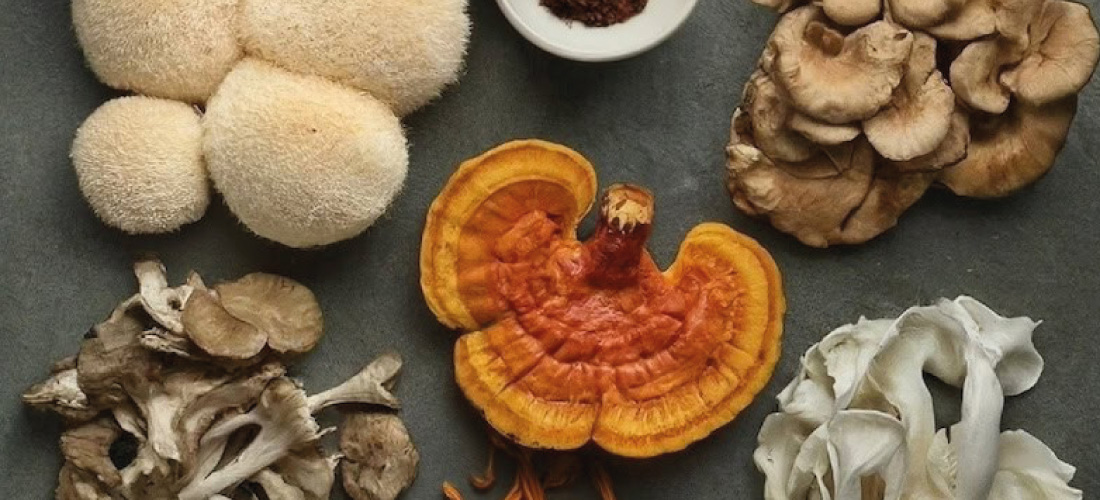
Fungi adaptogens are a unique group of fungi that have been used for centuries in traditional medicine, especially in eastern cultures. These fungi are known for their ability to help the body adapt to stress and restore balance, both physical and mental. Among the fungi thrive most popular are the reishi, cordyceps, the chaga, the mane of a lion, the agaricus blazei and physalis linteus.
Reishi (Ganoderma lucidum)
Ganoderma lucidum, known as lingzhi in China and reishi in Japan, he received the nickname of “the mushroom of immortality” and is one of the medicinal mushrooms traditional more venerable (1).
Normally exhibit a morphology similar to a hoof or a fan, and grows mainly in the trunks of living trees and dead. Its distribution encompasses Asia, parts of Europe, America and Africa, (2, 3).
Ganoderma lucidum has been used for over two millennia (4). Historical records, such as the Herbal Classic of Shennong, which dates from the first century a. C., and contemporary sources as the Pharmacopoeia of China, document the properties tranquilizers of the G. lucidum (5). This effect An-Shen has been used for centuries in the treatment of conditions such as restlessness, insomnia and palpitations (6).
Its application spans a broad spectrum of ailments, including chronic liver disease, hypertension, neurasthenia, insomnia, bronchitis, gastric ulcer, diabetes, and cancer (7). Due to its purported health benefits, and the alleged absence of adverse effects, Ganoderma has earned a distinguished reputation in eastern cultures such as herbal remedy for excellence (8).
Ganoderma lucidum contain approximately 400 biomolecules active (16), among which are the beta-glucans (polysaccharides) and triterpenoids as ergosterol (provitamin D2) and ganoderic acids. In addition, this mushroom is rich in omega-3 fatty acids, amino acids, vitamins, minerals and other bioactive substances.
It has been documented that the triterpenoid derived from Ganoderma lucidum (GL) exhibit a remarkable efficacy as adjunctive therapy, improving health and contributing to the treatment of various diseases, such as prostate cancer, inflammation, atherosclerosis, diabetes and neurodegenerative diseases (11).
Recent findings have confirmed its effectiveness, demonstrating improvements in sleep patterns of patients with insomnia or other mental disorders (13,14).
Reishi has shown a remarkable potential antidepressant and anxiolytic because of its interaction with the 5-HT2A receptor, presenting favorable clinical results in the treatment of insomnia, restlessness and palpitations (15). In addition, reishi has shown the ability to regulate the production of interleukins, such as IL-6 and TNF-α-63, by linking its immunomodulatory function with its role adaptogenic.
In addition, several studies have elucidated the pharmacological activities of the extracts of Ganoderma lucidum on the nervous system and the disorders related to the central nervous system (17, 18).
Abate M, Pepe G, Randino R, Pisanti S, Basilicata MG, Covelli V, et al. Ganoderma lucidum Ethanol Extracts Enhance Re-Epithelialization and Prevent Keratinocytes from Free-Radical Injury. Pharmaceuticals (Basel). 2020;13(9). doi: https://doi.org/10.3390/ph13090224
Wang SH, Liang CJ, Weng YW, Chen YH, Hsu HY, Chien HF, et al. Los polisacáridos de Ganoderma lucidum previenen la proliferación de células musculares lisas estimulada por el factor de crecimiento derivado de plaquetas in vitro y la hiperplasia neointimal en la arteria sin endotelio in vivo. J Cell Physiol. 2012;227(8):3063-71. doi: https://doi.org/10.1002/jcp.23053
Pinya S, Ferriol P, Tejada S, Sureda A. reishi Mushrooms (Ganoderma lucidum), shiitake (Lentinela edodes), maitake (Grifola frondosa). In: Nabavi SM, Silva AS, editors. Nutritional supplements without vitamins or minerals: Academic Press; 2019. pp. 517-526. 9780128124918.
Bishop KS, Kao CH, Xu Y, Glucina MP, Paterson RR, Ferguson LR. De los 2000 años de Ganoderma lucidum a los recientes avances en nutracéuticos. Phytochemistry. 2015;114:56-65. doi: https://doi.org/10.1016/j.phytochem.2015.02.015
National committee of the Pharmacopoeia. Pharmacopoeia of the people's Republic of China. 11.ª ed. China Medical Science and Technology Press, editor. Beijing, China, 2020.
Cui XY, Cui SY, Zhang J, Wang ZJ, Yu B, Sheng ZF, et al. El extracto de Ganoderma lucidum prolonga el tiempo de sueño en ratas. J Eth-nopharmacol. 2012;139(3):796-800. doi: https://doi.org/10.1016/j.jep.2011.12.020
Sanodiya BS, Thakur GS, Baghel RK, Prasad GB, Bisen PS. Ganoderma lucidum: un potente macrohongo farmacológicamente activo. Curr Pharm Biotechnol. 2009;10(8):717-42. doi: https://doi.org/10.2174/138920109789978757
Lee KH, Morris-Natschke SL, Yang X, Huang R, Zhou T, Wu SF, et al. Recent advances in research on medicinal mushrooms, food and other herbal products used in traditional chinese medicine. Journal of traditional and complementary medicine. 2012;2(2):84-95.
Gavalda J, Portela C. 12 medicinal Mushrooms for your health: Hifas da terra.
(10)Abdel-Azeem AM
Leave a Comment
Your email address will not be published. Required fields are marked *
You must be logged in to post a comment.